

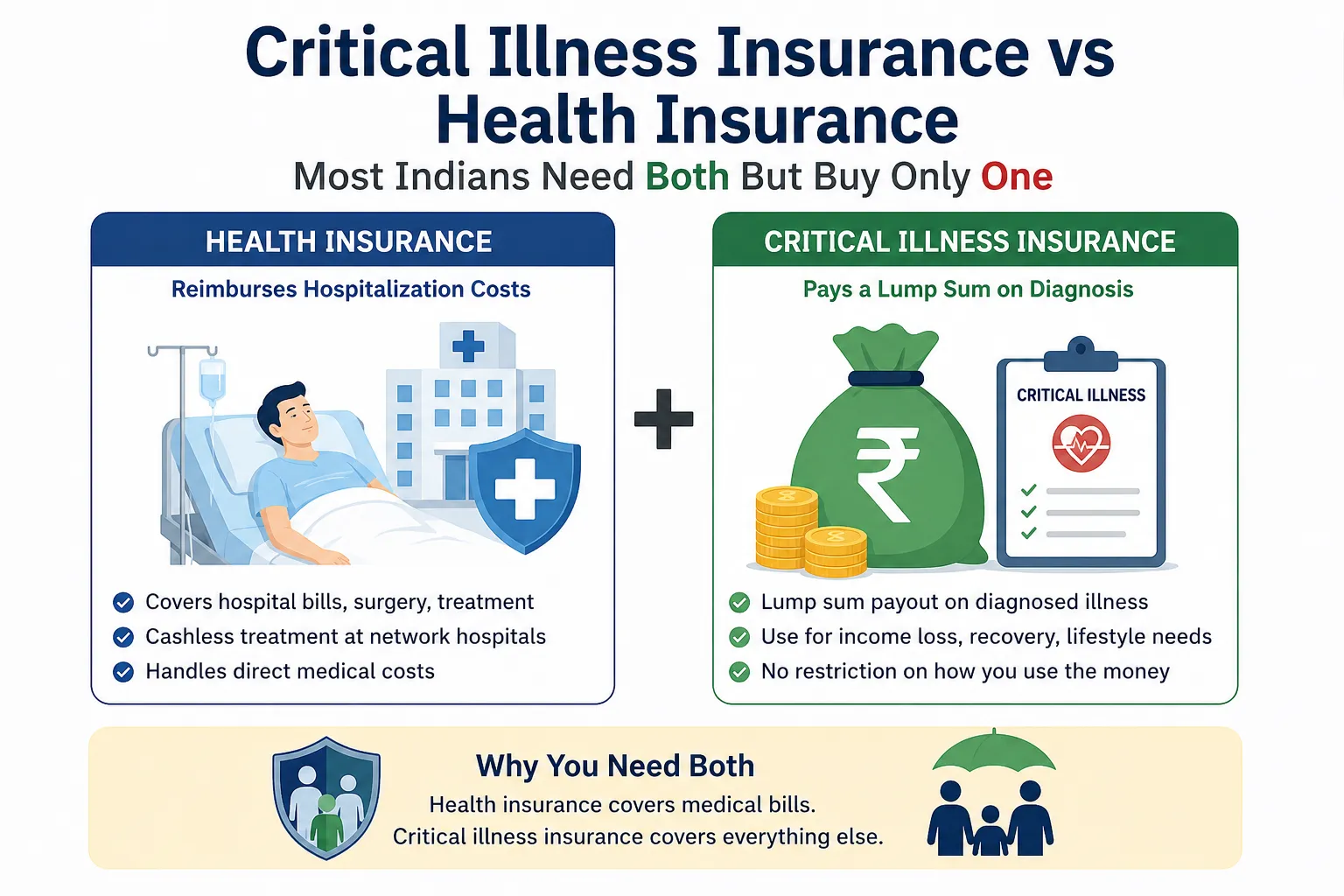
Ask most Indians if they have insurance, and the answer is usually “yes, health insurance.” Ask if they have critical illness cover, and the answer is often “isn’t that the same thing?” It isn’t, and this misunderstanding leaves millions underprotected against the financial shock of a serious diagnosis.
Health insurance reimburses hospitalization costs. A standard health insurance policy covers hospital bills, surgery costs, pre- and post-hospitalization expenses, and sometimes daycare procedures, typically through cashless treatment at network hospitals. It’s designed to handle the direct medical cost of an illness or injury.
Critical illness insurance pays a lump sum on diagnosis. This is a fundamentally different product. Once you’re diagnosed with a covered condition, commonly cancer, heart attack, stroke, kidney failure, or major organ transplant, the insurer pays out a predetermined lump sum, regardless of actual treatment cost. This payout isn’t tied to hospital bills at all.
Why the distinction matters financially: a serious illness doesn’t just generate medical bills; it often triggers a much larger financial disruption: loss of income during recovery, long-term medication, travel for specialized treatment, home modifications, or a caregiver’s reduced working hours. Health insurance covers none of this. Critical illness cover, precisely because it pays a lump sum with no restriction on usage, can be used to replace lost income, cover non-medical expenses, or fund private treatment that exceeds standard hospitalization limits.
The gap most people don’t see. Even with a robust ₹10-20 lakh health insurance policy, a cancer diagnosis can result in months of reduced income, extended outpatient chemotherapy not fully covered by hospitalization-based plans, and family financial strain that has nothing to do with the hospital bill itself. This is precisely the gap critical illness insurance is designed to close.
Why most people skip it: critical illness plans are often perceived as an unnecessary add-on since people assume “I already have health insurance.” Premiums, while modest relative to the payout, feel like an additional cost people are reluctant to take on, especially when critical illness feels like a distant, low-probability risk until family history or a health scare changes that perception.
Who needs both most urgently?
-
Sole or primary earners whose income would be directly impacted by extended illness.
-
Individuals with a family history of cardiac conditions, cancer, or diabetes-related complications.
-
Anyone whose existing health cover has hospitalization sub-limits or co-pay clauses that reduce actual payout.
-
Self-employed professionals with no employer-provided income continuation during illness.
The right approach isn’t choosing one over the other; it’s layering critical illness cover on top of a solid health insurance base, sized according to your income, dependents, and family medical history.
If you’re unsure whether your current health insurance is adequate or whether you need standalone critical illness cover, you can explore insurance options tailored to your profile at Airpay Money, which connects you with trusted insurers to compare plans side by side.